


What Does It Say About Us That We Can Survive Oppression, but not Conflict?
Trans Migrations & Monday Meditations
I have been sitting with a lot of information this year. It’s been strange to tap into it all while I’ve been on the road eating with strangers. And, just recently, a dear friend reached out to me to see if I had heard of the allegations against Francis Weller.
Francis Weller was recommended to me and I quickly devoted his book, The Wild Edge of Sorrow. It helped me transform the grief I was and am experiencing into a better metabolized alchemy. I recommend his books. Then, I attended a grief retreat that helped me further metabolize the great harm and grief I had experienced throughout my life. Francis Weller was a bit of a hero to me!
I had not yet heard the news, but soon was caught up with the story of harm, yet again.
I was not surprised, because I am as compromised as Francis Weller. I have been conditioned to do harm. From being socialized in Texas thru graduate school, I have been conditioned to be just as genocidal as others.
We cannot outrun harm.
When will we reckon with power that is alive and accelerating today?
One day, I was reading on Substack for research and work and came across the Erotics of Liberation. I was struck by their proposition that we can survive oppression, but not conflict, and I’ve been sitting with this since I read it. I even mentioned it to my therapist who asked me to hold this as a question and not a solid / certain framework.
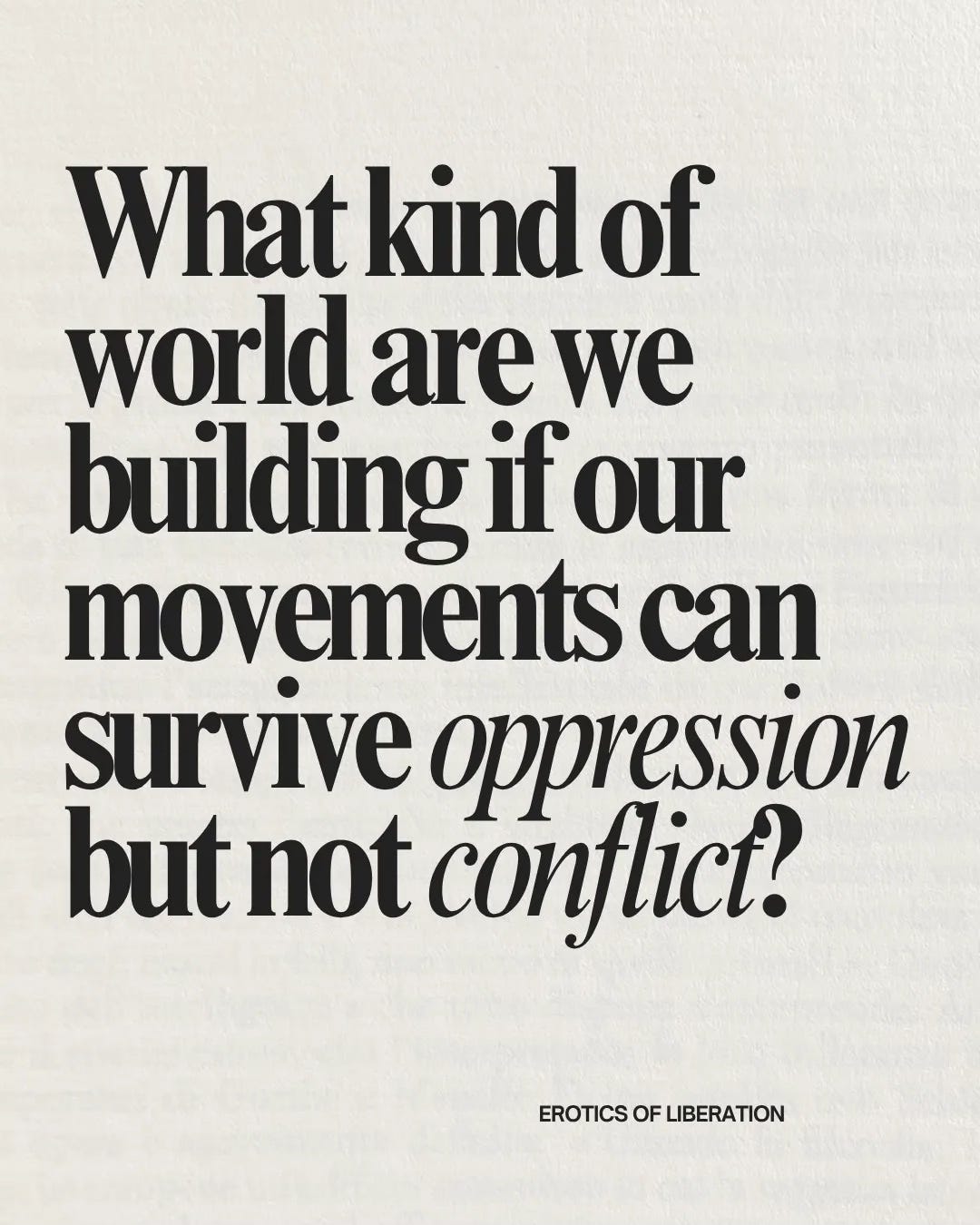
I appreciated this nudging me to hold it as a question instead of a declarative statement. Though the declaration that we can survive oppression but not conflict is very evocative to me!
“Conflict is the spirit of the relationship asking to be deepened.” Maledome
Another person who is charged with harm is the above author who speaks of conflict as the spirit of the relationship asking to be deepened.
I don’t know what to do with the fact that we are all compromised.
In very large and small ways.
I don’t know what to do with the fact that most all of my sources are compromised and I am building another possible world in the shell of its own. I asked my academic partner what do ethical futures really look like when everyone is compromised?
I tend to be a Stranger in the Village when I travel. I observe my context and learn the rules of engagement, then engage. Connection seems to be the thing missing from every context I encounter.
How do we connect in the face of conflict and oppression?
The whispering trees tell me something along with the symphony of birds that appear each morning. The tall pine trees of Little Rock remind me of East Texas, as do the valleys of Western New York. Place matters so much.
The question I have been asking myself is how do we connect right now with so much collapse and devastation? Even I have caused harm and haven’t known what to do about that. I remember being called out on social media and not realizing that the very systems I had invested in were the very systems that I was using to cause harm. I was devastated to learn that my conditioning was also gennocidal. I remain devastated adn am trying to compost this awareness into ethical masculinities.
The places that I call home are many. One place that I call home is Alfred, NY, a place riddled with histories of settler colonialism that founded an academy in the village that has become the mirror of the oppression we are all surviving. This place I call home is complete with various conflicts. I even hear there is chrome in the soil but no one will test it to learn how compromised the soil is.
Conflict will outpace us, if we do not earn how to be in right relationship with each other.
One of the things I have learned is that relationships take a lot of practice, every day maintenance. And, one of the things we need right now are rituals.
No, we don’t need the dogma or the nostalgia of the church; we need rituals to bring us back together in right relationship. We need grief rituals; we need celebrations; we need ceremony. Conflict today is asking us to go deeper and to listen to the wisdom of our bodies. Our bodies are craving for a re-mem-bering with land, people, food, animals, and all living things.
When I am invited to come eat with folks, I am at the mercy of people and their dysfunction, and I remember that God’s mercy extends to us all, so I practice and work to be in right relationship. We need small doses of dopamine, so that we survive the collapsing devastation of the Imperial West. We are in a kairos moment in so many ways.

What we need is a deep political practice of listening to and with one another with deep care and the utopic vision of another possible world.
My friend, Clifton L. Granby has just written on the racial politics of listening that might help us right now! Click here to order the book!
Granby’s The Racial Politics of Listening aligns with work that seeks to make institutions, conversations, research, or creative practice more just and accountable: it argues that listening is never neutral, because power determines whose knowledge is trusted, dismissed, or made invisible. Its central invitation is to move beyond surface-level inclusion toward “deference”: deliberately redistributing attention, credibility, and authority to people and traditions historically marginalized. If your work involves equity, community engagement, education, culture, storytelling, or organizational change, the book offers a strong framework for treating lived experience not as supplemental input but as essential expertise. I urge you to go get this book, which was just released this past week!
If I’ve learned anything these past 9 months of eating with strangers for auto-ethnographic research on belonging and freedom, it is that we need a social practice that can shape us into a better body. A better flock. A more generative herd of people working interdependently to achieve another possible world. We must come to understand the conflict that exists. There are many.
A book I recommend right now in addition to Clifton’s book is From the Clinic to the Streets Psychoanalysis for Revolutionary Futures. Learn more here: https://www.plutobooks.com/product/from-the-clinic-to-the-streets/.
May we develop a better practice of listening to ourselves, so that we can hear each other into speech and learn to practice with one another another possible world. This requires pace and place to be right, too. When we recognize that we are each compromised, we will be better able to endeavor to be in right relationship with all manner of things.
If you want to support this work, please consider subscribing to this Substack. The money we receive from Substack helps us pay for the meals we have when we are out in the world. We buy locally wherever we are. If you want to become a sustaining supporter of this work, please see our website Our Collective Becoming.
We are working to fundraise for heating in our 2nd program space and community supported yoga. We are looking for 100 people to give a sustaining donation of any amount! To give, click here.
Your sustaining support of OCB means that we can keep our resources free. We will be creating a resource this fall on belonging and freedom and what we can learn from ways we gather together. Look for that to be released here on Substack in the coming months.
We are about 1/2 to our goal that our Living Project, Rev. Jennifer Harris Dault set, so please join us in giving to meet our goal!
May we endeavor to build another possible world together and interdependently. Be kind in the world where only tough bastards seem to matter!
Paz, —RCE+
My husband died almost 2 years ago. I have been listening to a grief meditation. In this meditation, this woman states that something that helped get her through her grief was the possibility that we selected this life. I like the idea that maybe we are here to learn. Maybe before we were born we selected our coursework. Maybe as humans we are finding out that human life in the physical world is different than whatever came before and what comes after.