


Dear Becoming Ones:
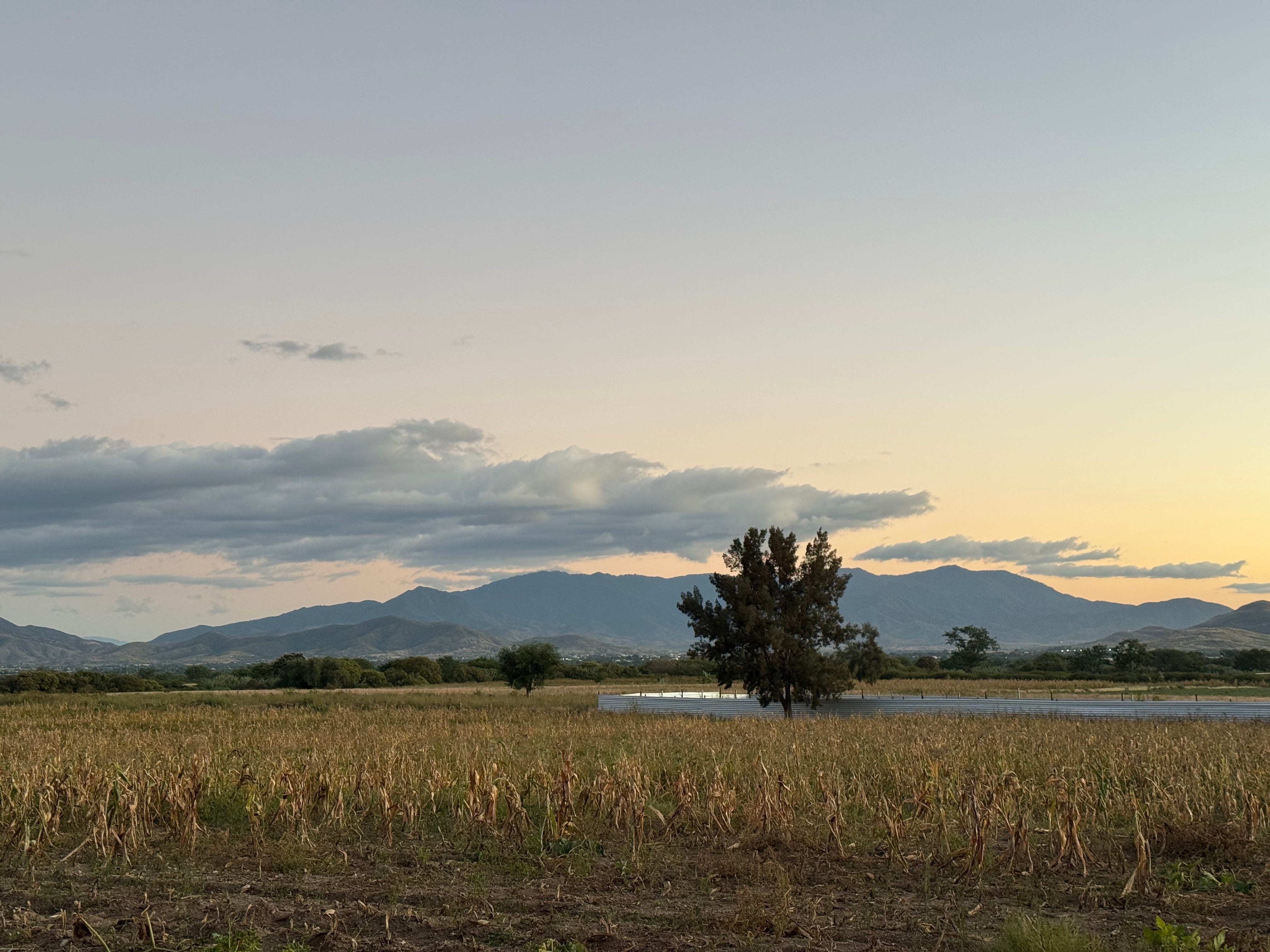
Each correspondence begins in iOS notes, savored for a bit, then transferred to Substack to be sent out and then arrive by email and on the Substack App. So, this afternoon, on Día De Los Muertos, I am sitting in Oaxaca listening to WFUV out of NYC.
Each Sunday, I listen to Irish music all day. And, so, it seems fitting to be writing in Oaxaca, Mexico, my ancestral home, listening to Irish music, to honor my white ancestors. After all, I am trying to beckon my ancestors and welcome them into my life. I wish to receive their blessing.
Sound has always been important to me. The sounds of nature and the sounds of the call to prayer in the Old City of Jerusalem both compel me. The sounds of ritual call to me, like the heartbeat yesterday in the Temescal where I sat for two hours sweating in nothing but a pair of shorts that were drenched after two hours of a hot stone sauna.
The sounds I am listening to now are ancient sounds that I am only now beginning to know. I love Trad music when I’m in Ireland, especially in Belfast where I attended the Trad festival one year. Now, each Sunday, I tune into WFUV via my app and stream the radio station all day.
On Sundays, they stream a Catholic Service that I listen to, along with attending Reba Place Church, online, where I am a member by distance. It’s good to be held by many voices and sounds.
So, today, I am held by the sounds of my white ancestors and on ancestral land celebrating Día De Los Muertos, welcoming the Muertos in and receiving their blessing.
I am a borderlander, (ni de aquí, ni de allá) - Following Gloria Anzaldúa, I borrow this term and use borderlander to describe myself. I inhabit and negotiate intersecting cultural, social, or identity boundaries, often experiencing a sense of belonging fully to neither side (ni de aquí, ni de allá). I understand this position not only as exclusion or in-betweenness, but also as a site from which new identities, relationships, and ways of knowing can emerge.
I have spent a year traveling doing auto-ethnographic work. Yet, I am trained as a Liberationist and look to Gloria Anzaldúa’s innovative onto-ethico-epistemological paradigm of utohistoria-teoría.
The queer Chicana Tejana feminist theorist, Gloria Anzaldúa, created an innovative theory, autohistoria-teoría, that is a way of writing that brings together personal and cultural history, storytelling, memory, and theory. It uses the writer’s lived experience—including embodied and emotional experience—as a source for making knowledge and examining broader social and political realities.
I have been doing this work all year around belonging and freedom: food, art, & ritual. I have traveled internationally and was hosted by people in Zurich, Belfast, London, Cork, and Verona. Each of these stops were a chance to practice being in right relationship with people, despite how dislocated we are from one another.
As the year comes to a close, I had a chance to be hosted in Mexico, in my ancestral home for Día De Los Muertos, all by chance. I sometimes can’t believe my life!
When I received an invitation to attend a 3 day ceremonial gathering on Indigo, as a plantcestor, to bear witness and help steward the story of Indigo, I said “yes.” Remembering that both my “yes” and “no” are sacred, I leaned into what ceremony might have to teach me about belonging and freedom.
Saying “yes” to Indigo meant also saying “yes” to returning home from Santa Fe, NM to Oaxaca with a dear one, and having a chance to lean into another possible world on ancestral land. We traveled a very weird route to get to Mexico City where we took an overnight bus to Oaxaca where we were then retrieved and later settled into the valley.
Saying “yes” to ritual has brought people into my life; saying “yes” has brought medicine into my life.
I have been reading the Baldwin biography, as you know, and I give it away to people who I think could benefit from it.
Relationships saved Baldwin, and this year, relationships have saved me.
As I continue along my path of relational discernment, I have come to see who was interested in being in proximity to me when I was more in public life as a speaker, before I embraced my vocation as a writer and social critic and hermit life.
Relationships will save us.
It’s relationships all the way down. I believe this with every cell in my being.
The reason I believe that it is relationships all the way down, is because I was introduced to a concept in a book I read in seminary two decades ago, God in Creation by Jürgen Moltmann. He coined the term: panentheism.
Panentheism understands the world as existing within God, while affirming that God is more than the world. In this view, God is present throughout creation, yet creation is not identical with God. Jürgen Moltmann offers an influential modern Christian account of panentheism, connecting divine presence with the ongoing relationship between God and the created world. Panentheism is the view that all things exist in God, while God is more than the world. It differs from pantheism, which identifies God with the universe itself: in panentheism, the world is within God, but God also exceeds it. Jürgen Moltmann developed an influential modern Christian account of this idea, describing creation as existing in God while remaining distinct from God. Moltmann, God in Creation
I have had people exit my life over the past several years as I have become much more reclusive and private, instead of so very public. This has been clarifying for me.
I have had people step up and enter my life, and this is why I am in Mexico.
Years ago, during the pandemic, I asked a public intellectual to endorse my second book, Body Becoming, and he did. His name is Bayo Akomalafe, and when he learned that my ancestral home is Oaxaca, he made sure I met the Lead Weaver at ten, Aerin.
Aerin and I have been exchanging emails and texts for the past several years and we were both invited to the Indigo Gathering, which is where we finally got to meet and have some embodied time together. When we discovered we were both going to be in Santa Fe at the Indigo Gathering, we decided I would come home with her and join her family for Día de Los Muertos. She’s also the one who turned me onto the artist residency I am doing in Oaxaca next year. I applied all over the US, but no such luck! Yet, Oaxaca wanted me!
Relationships and interrelatedness and interconnection is what will save us right now in an age of disconnection, hyper individualism, and busyness.
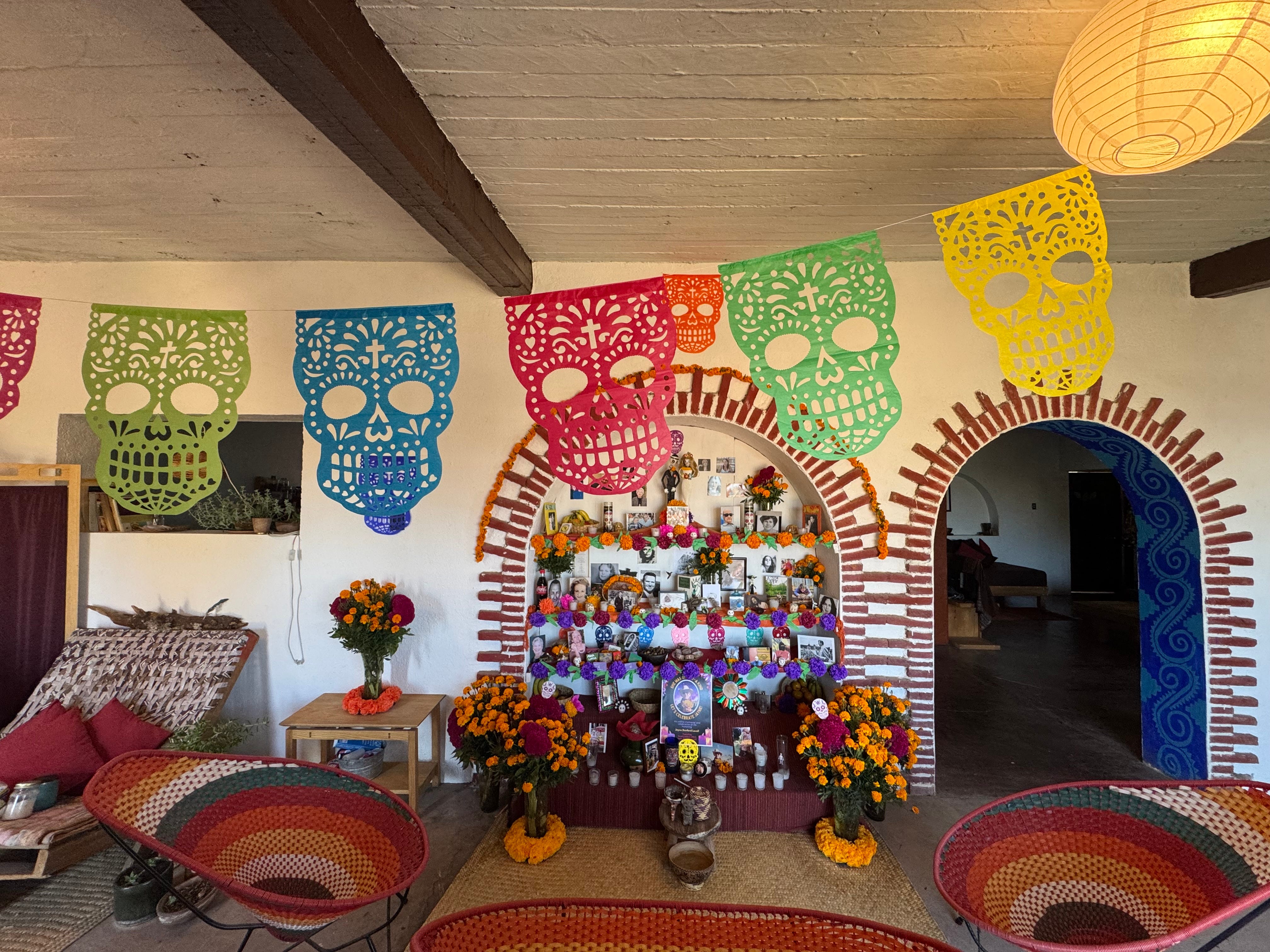
Today, I have been sitting at the altar welcoming the ancestors. I ate lunch at the altar. Yet, for writing this correspondence to you, I wanted to sit outside and listen to music and appreciate the nice weather. The sounds of the Irish grace my ears and I am caught up in this moment of being alive. Each day is another day to make another possible world real.
Sound is medicine to me. From the drum beat that is the heartbeat of ceremony to the emerging sound projects that reflect belonging and freedom, sound will be a part of re-imagining the world as we know it and hospice modernity; compost the fucking patriarchy; and, love like we have never loved before! Or, as Dean Spade wrote: loving in a fucked up world!
Since the year is coming to a close, I needed to wrap up my research and figure out how to take the next step toward producing a project, and after receiving a couple of invitations to Mexico, I decided to take advantage of the time away and continue to delve into the various elements of this emerging project around belonging and freedom: food, art, ritual.
I’ll soon be with Alex Wong to work on some sonic projects related to this next project, which continues to shape and shift in a variety of ways.
Relationships can be medicine for our soul, and I’m so grateful for the soul medicine I am receiving right now. Reading the Baldwin biography is teaching me that even, he, struggled with love and companionship. I am finding companionship along the way, and grateful for my teacher, Dr. Nancy Bedford, who continues to accompany me in a variety of ways, including adopting me into her family and sharing her family with me.
I could list others, but I am far too private to kiss and tell right now. Just know, I am grateful for the companionship and I’m learning that we need each other right now. I’m learning that my heart is healing from a lifetime of trauma and dysfunction within the church, academy, and the movement, along with my own family.
Relationships saved Baldwin and I want to follow in his footsteps in many ways. I know how badly I need relationships. I know how badly I need companionship with touch.
You might wonder what the meditation part of this letter is. I think it is found in the deep contemplation of how we might nurture right relationship right now. I know for me, I am dancing with someone cultivating a permaculture garden, plating seeds of trust, and paying attention to how nature will teach me how to be in right relationship, and I am grateful my dance partner also looks to nature and permaculture to direct them.
I am going to wrap up this correspondence and ask you to consider what I have written here.
What relationships serve you?
What relationships are labor for you?
Who wants to be close to you for what you can do for them?
How might you look to nature to learn how to imagine right relationship?
We desperately need to weave together a life of togetherness. It doesn’t need to look any certain way, but it does need to be prioritized in an age of violence and exclusion.
Might we stop othering each other and give up on logics of identity and look to another way to connect?
It’s relationships all the way down for me.
I cannot unsee what I see and what I know about how culture and community are both simultaneously living and breathing ecosystems of constant change and transformation.
Yours, in the struggle for another possible world! I remain chaste for liberation!
Paz, —RCE+
Some things need to be written.
One of my favorite prayers comes from the German mystic and liberation theologian Dorothee Sölle. Her life integrated beautifully the depths of contemplative spirituality with the urgency of justice.
Dream Me, God
It’s not you who should solve my problems, God,
but I yours, God of the asylum-seekers.
It’s not you who should feed the hungry,
but I who should protect your children
from the terror of the banks and armies.
It’s not you who should make room for the refugees,
but I who should receive you,
hardly hidden God of the desolate.
You dreamed me, God,
practicing walking upright
and learning to kneel down —
more beautiful than I am now,
happier than I dare to be,
freer than our country allows.
Don’t stop dreaming me, God.
I don’t want to stop remembering
that I am your tree,
planted by the streams
of living water.